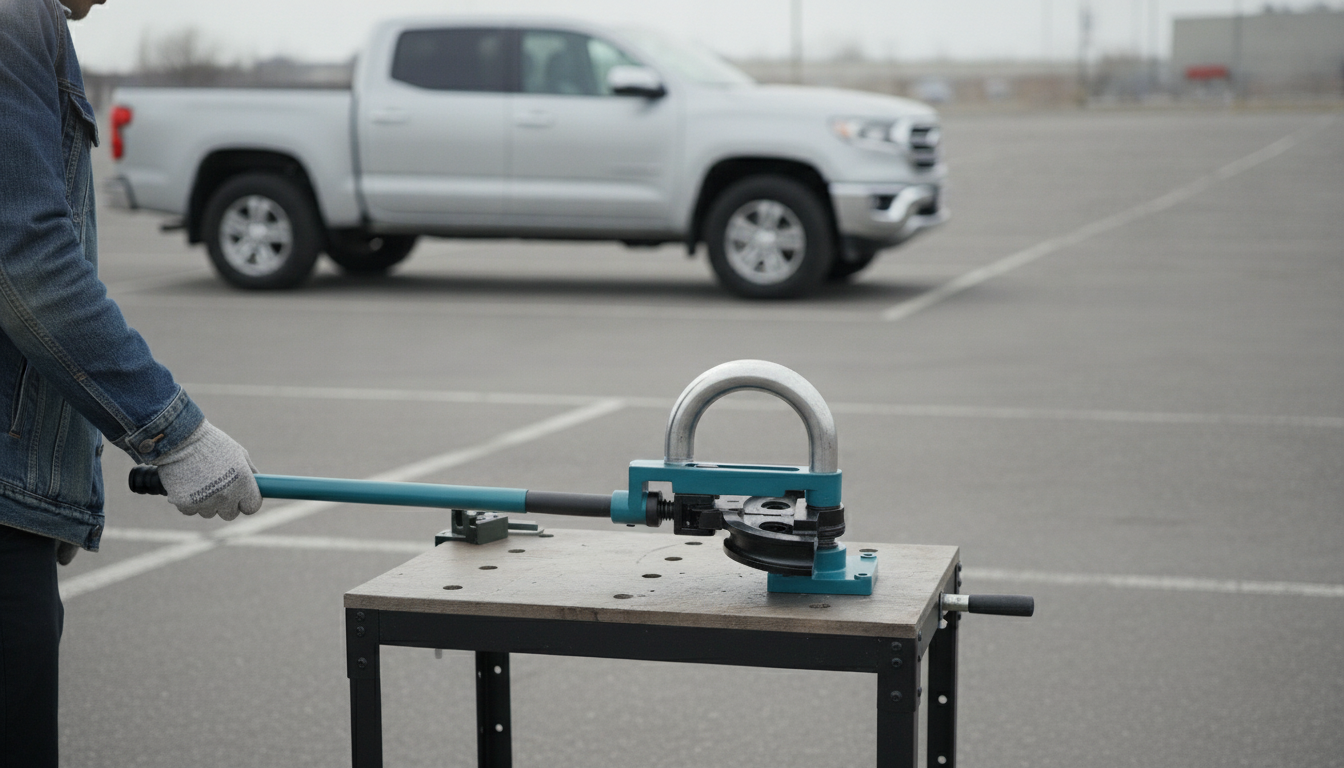
A hydraulic pipe bender lets you form smooth, consistent bends in pipe or tubing with less effort than manual tools. The key is matching the right die and shoe to your pipe size and material, setting up the bender on a stable surface, and making the bend gradually while checking angle and alignment as you go.
Confirm the bender’s capacity covers your pipe’s outside diameter and wall thickness. Install the correct die (often called a former) and follow shoe/roller for that pipe size; the wrong die can flatten the pipe or cause wrinkling. If your bender supports multiple materials, check the manufacturer guidance for steel, stainless, aluminum, or copper.
Measure from a known reference point and mark the centerline of the bend on the pipe. If you need a precise offset or multiple bends, mark all reference lines before bending and note the orientation so the pipe doesn’t twist between bends.
Place the bender on a level, solid surface and verify the frame and pins are fully seated. Position the pipe in the die so your bend mark aligns with the die’s center indicator (if present). Keep your hands clear of pinch points around the die and rollers.
Pump the hydraulic handle to start the bend. Bend in small increments, pausing to confirm the pipe stays centered and doesn’t rotate. Use an angle gauge or square to check progress; many bends “spring back” slightly when pressure is released, so you may need to overbend a few degrees depending on material and wall thickness.
Open the release valve slowly to retract the ram, then remove the pipe. Inspect for flattening, kinks, or cracks. If the bend is short of target, reposition carefully and add a small amount of bend rather than trying to force a large correction at once.
For a more detailed walkthrough, safety notes, and tips to prevent wrinkling and deformation, see How to Use a Hydraulic Pipe Bender.
Use the correct die size, keep the pipe fully seated and aligned, and bend gradually. Thin-wall tubing may require a tubing bender designed for it or added internal support (like a mandrel or filler method) depending on the application.




Leave a comment