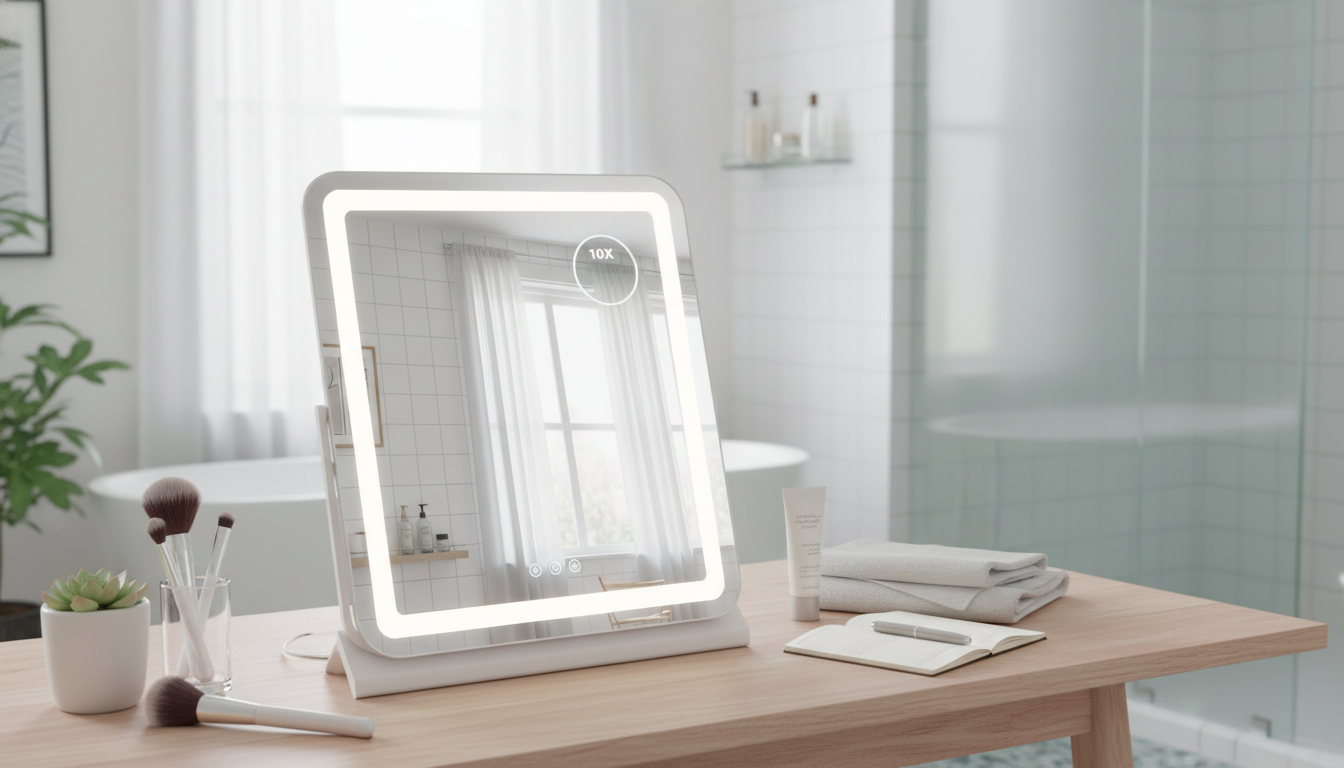
A lighted vanity mirror with strong magnification and dimmable lighting helps dial in makeup details, precise grooming, and skincare checks without harsh shadows. The right combination of 10X clarity and adjustable brightness supports close-up tasks while keeping lighting comfortable for different rooms and times of day. With a few smart habits—like finding the correct focus distance and matching light levels to real-life conditions—you can get cleaner lines, more even blending, and fewer “missed spots” that show up later.
10X magnification shines when you’re doing work that’s simply hard to see in a standard mirror. It’s especially helpful for quick precision tasks where accuracy matters more than seeing your whole face at once.
If your eyes start to feel tired, lower the brightness, take a short break, and come back for the final touch-ups. For additional guidance on discomfort and fatigue, the American Academy of Ophthalmology’s overview of eye strain is a helpful reference.
Even great magnification can fall short if the lighting is too dim, too harsh, or coming from the wrong angle. Adjustable brightness lets you customize the mirror’s light to your room, your routine, and your comfort level.
Lighting quality matters, too. LEDs are often favored for their efficiency and consistent output; the U.S. Department of Energy’s LED lighting guide breaks down why LED illumination is commonly used for everyday tasks.
Brightness isn’t only about “more.” The goal is a realistic, even view that helps you apply product the way it will look in normal settings.
| Task | Suggested brightness level | Why it helps |
|---|---|---|
| Skincare application (serums, moisturizer, sunscreen) | Low to medium | Supports comfort while still showing coverage and absorption |
| Foundation and concealer blending | Medium | Reveals edges and blending without exaggerating texture |
| Eye makeup precision (liner, mascara, lash placement) | Medium to high | Helps spot gaps and improve accuracy |
| Brow shaping and tweezing | High | Makes fine hairs and symmetry easier to see |
| Final check (overall balance and symmetry) | Medium, then brief high | Confirms realism first, then catches small misses |
When applying sunscreen, it’s also useful to see whether you’ve covered easy-to-miss zones (around the nose, hairline, and jaw). The American Academy of Dermatology’s sunscreen FAQs can help you validate best practices for daily protection.
A few small adjustments can make a magnifying mirror feel dramatically easier to use—especially when you’re aiming for clean symmetry.
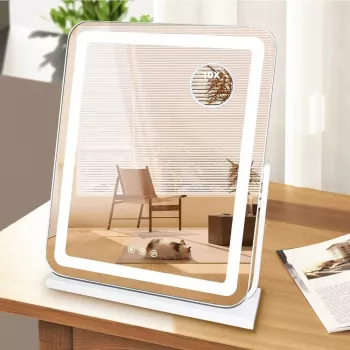
If you want one tool that supports both close-up detail work and more comfortable everyday lighting, Lighted Vanity Mirror with 10X Magnification and Adjustable Brightness is designed to make precision tasks easier to manage.
If your routine includes watching tutorials, checking shade matches online, or doing your makeup near a laptop, Anti-Blue Light Gaming Glasses can be a practical companion—especially during longer sessions where eye comfort matters. For the most accurate makeup results, do your final checks in the mirror under your chosen brightness setting rather than relying on screen color.
10X magnification usually looks sharp only at a close viewing distance. Move the mirror slowly toward or away from your face until the image “snaps” into focus, and use that distance as your comfort zone (it can vary by eyesight).
Adjustable brightness makes it easier to match your room lighting, reduce glare, and do more realistic checks. Medium brightness typically works well for base makeup, while higher levels are best used briefly for detail work like tweezing or liner edges.
Yes—very bright or uneven lighting can push makeup to look heavier than it will in normal daylight. Do a final check at a moderate brightness similar to everyday indoor light, then do a quick high-brightness scan to catch small misses.




Leave a comment